
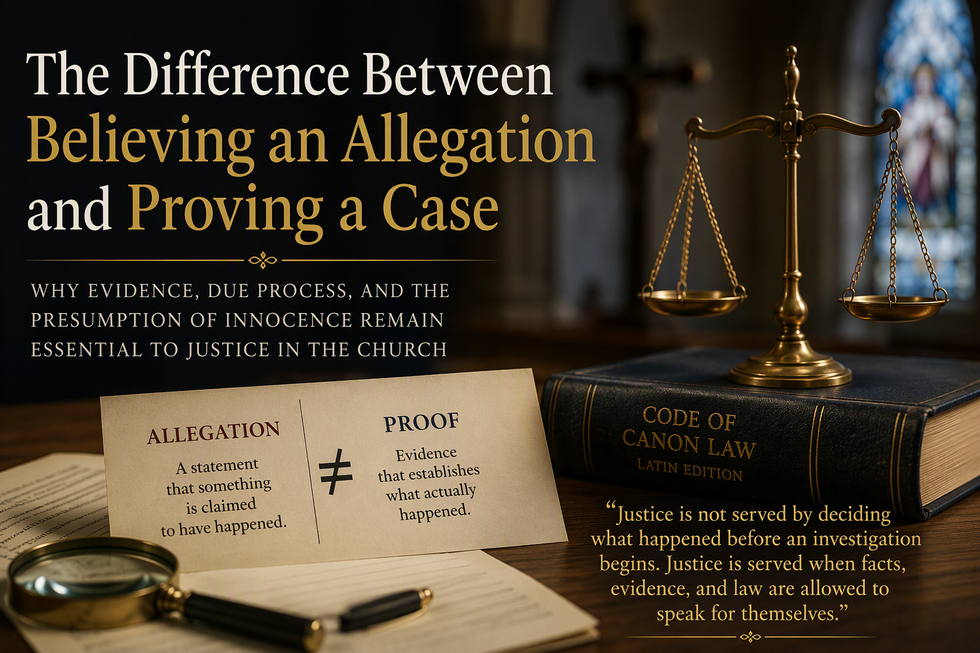
One of the most persistent misunderstandings in both civil and ecclesiastical proceedings is the assumption that an allegation becomes more credible simply because it is sincerely made. While sincerity may speak to an individual's subjective conviction, it does not establish the objective truth of what is alleged.
This distinction is not merely a technical legal concept. It lies at the heart of justice itself.
The Temptation to Collapse the Distinction
When serious allegations arise, particularly those involving clergy, Church leaders often face tremendous pressure to respond quickly. Public concern, media attention, and the understandable desire to demonstrate care for potential victims can create an atmosphere in which mere accusations are treated as though they have already been proven.
Yet the Church's legal tradition has consistently recognized that accusations and proof are not synonymous.
A person may honestly believe something occurred and still be mistaken. Memories can fade. Perceptions can be inaccurate. Assumptions can be incorrect. Witnesses can misunderstand events. None of this requires dishonesty. Human experience itself demonstrates the fallibility of perception and recollection.
The search for truth, therefore, requires more than accepting a narrative at face value.
The Purpose of an Investigation
An investigation does not exist to confirm an allegation. It exists to determine whether an allegation can be substantiated.
This distinction is critical.
An investigator who begins with the assumption that the accusation is true is no longer engaged in fact-finding. Instead, he or she risks becoming an advocate for a predetermined conclusion. Such an approach inevitably leads to confirmation bias, where evidence supporting the allegation is emphasized while evidence pointing in another direction is minimized or disregarded.
Justice requires a different posture.
The investigator must remain willing to follow the facts wherever they lead, whether those facts support the allegation, undermine it, or reveal a more complicated reality.
The Presumption of Innocence Protects Everyone
Some critics view the presumption of innocence as a protection afforded only to the accused. In reality, it serves a much broader purpose.
The presumption of innocence safeguards the integrity of the process itself. It ensures that decisions are based upon evidence rather than emotion, pressure, or conjecture.
A system that abandons the presumption of innocence for one person can abandon it for anyone.
History repeatedly demonstrates that procedural protections are most important when public opinion urges their abandonment. Fair procedures are easy to support when a person is popular or sympathetic. Their true value is tested when allegations provoke anger or outrage.
The Church's legal tradition recognizes this reality and insists that justice demands more than good intentions.
Compassion and Due Process Are Not Opposites
A false choice is frequently presented in contemporary discussions: either believe every allegation immediately or show concern for the rights of the accused.
Such a choice is unnecessary and fundamentally flawed.
The Church can care for those making allegations while simultaneously ensuring that accusations are investigated fairly. It is entirely possible to offer pastoral assistance, emotional support, and appropriate safeguards without abandoning the obligation to determine what actually occurred.
Indeed, genuine concern for all involved requires precisely that approach.
Neither alleged victims nor accused persons are served by conclusions reached without reliable evidence.
Truth Remains the Goal
The ultimate purpose of every ecclesiastical process is not the vindication of an accuser, the exoneration of an accused person, or the protection of institutional interests.
The goal is truth.
Truth sometimes confirms an allegation. Truth sometimes disproves an allegation. Truth sometimes reveals that certainty cannot be attained from the available evidence.
Whatever the outcome, justice requires the courage to follow the evidence rather than assumptions.
The distinction between believing an allegation and proving a case may appear subtle. In reality, it is one of the most important safeguards in any legal system. Once that distinction is lost, the pursuit of truth gives way to the pursuit of conclusions.
The Church, whose legal tradition has long emphasized the dignity of every person and the demands of justice, can ill afford such a loss.
"Justice is not served by deciding what happened before an investigation begins. Justice is served when facts, evidence, and law are allowed to speak for themselves."

Comments
There are no comments for this post. Be the first and Add your Comment below.
Leave a Comment