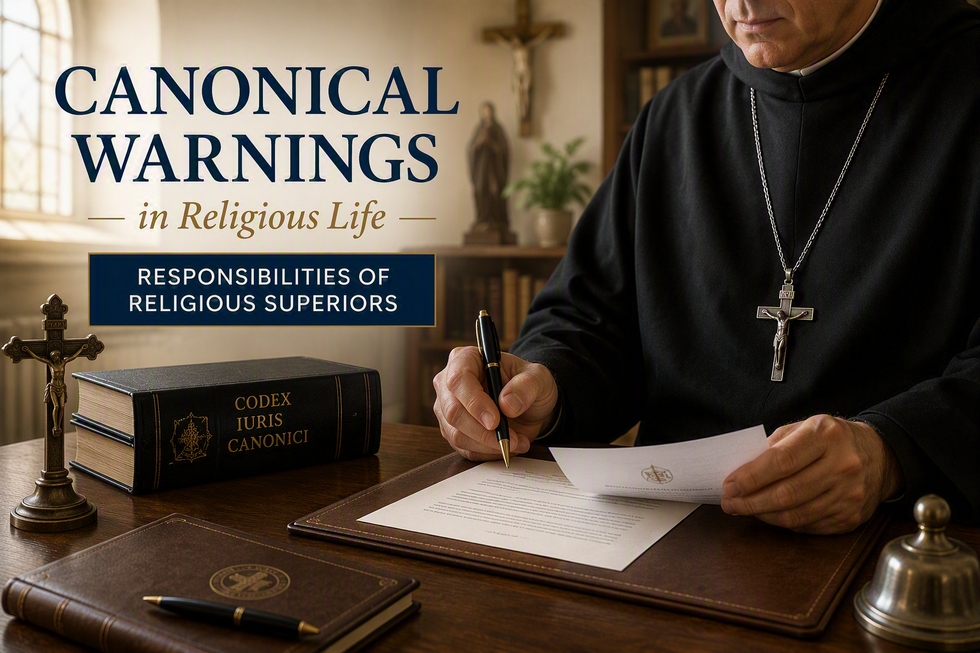
Canonical Warnings: Why Religious Superiors Must Address Persistent Disobedience
One of the most difficult responsibilities entrusted to a religious superior is responding appropriately when a member persists in conduct contrary to the obligations of religious life. Superiors naturally desire reconciliation and voluntary compliance. Nevertheless, canon law sometimes requires a more formal response.
A canonical warning is not primarily a punishment. It is a pastoral and juridical instrument intended to give the member a clear opportunity to correct harmful behavior before more serious consequences become necessary.
The Purpose of a Canonical Warning
Religious life is founded upon the evangelical counsels and lived within a framework of common discipline. When a member repeatedly refuses legitimate directives, abandons assigned duties, or otherwise acts contrary to serious obligations, the superior must address the situation for the good of the member and the institute.
A canonical warning serves several important purposes.
First, it clearly identifies the conduct that must cease.
Second, it establishes a reasonable period for amendment.
Third, it warns the member of the consequences that may follow if the conduct continues.
Finally, it demonstrates that the institute has acted with both justice and charity by providing every reasonable opportunity for correction.
Why Informal Conversations Are Often Insufficient
Many superiors are reluctant to move from informal dialogue to formal warnings. They understandably hope that a member will respond to fraternal correction. However, repeated conversations that produce no change can create uncertainty and ultimately weaken the institute's ability to respond effectively.
A formal warning creates clarity. The expectations are stated in writing. The member understands precisely what is required. The institute's concern is documented, and future decision-making is grounded in a transparent record.
The Balance Between Charity and Governance
Effective governance requires both compassion and firmness. A superior who ignores persistent misconduct risks harming the common good of the community. Conversely, a superior who acts precipitously without observing canonical procedures may undermine the rights of the member.
Canon law seeks to maintain this balance by emphasizing correction before punishment and amendment before dismissal.
Practical Considerations for Superiors
Before issuing a canonical warning, superiors should carefully document relevant facts, maintain appropriate records of communications, and ensure that directives are clear and capable of compliance. Ambiguous expectations often become a source of future disputes.
Where serious concerns exist, consultation with competent canonical counsel can help ensure that the institute's actions respect both justice and due process.
Conclusion
Canonical warnings should not be viewed as signs of failure. Properly used, they are instruments of pastoral governance that protect both the rights of the individual member and the good order of the religious community. Frequently, a well-crafted warning accomplishes exactly what the law intends: it prompts reflection, correction, and reconciliation, making further measures unnecessary.

Comments
There are no comments for this post. Be the first and Add your Comment below.
Leave a Comment